
The heat-death of SaaS

Why do we need another post on what’s happening in SaaS? In the immortal words of Randall Munroe: Someone is *wrong* on the internet.

“Will companies vibe-code systems of record” is the wrong question
Most enterprises intrinsically understand:
It was always the “service” portion of “software as a service” that was valuable. An MVP is about 5% of the work. Even a production-grade product is only about 20% of the work. The rest is maintaining it: new integrations, features, UX improvements for new users, whack-a-moling edge cases... and a dozen other things.
The risk (not to mention maintenance cost) of reinventing a core system is not worth the 0.1% of OpEx they’ll save.
Of course smart CIOs won’t make this tradeoff. But just because enterprises, broadly, won’t vibe-code internal systems... doesn’t mean no-one will.
We are seeing a massive surge of new-age SaaS startups who are coming for the systems of record. The pot of gold in each of these categories is huge. Jury’s still out, but they have better odds of winning than they ever did. The giants are vulnerable.
Moat #1: “SoRs are extremely flexible — they work for 100- and 100,000-person teams — which is really hard from an engineering perspective”
Why it’s fading: Generating a LOT of code to cover every possible edge case is something Codex & Claude are exceptional at.
Moat #2: “Decades of regulatory requirements, compliance rules, and domain expertise are baked into millions of lines of code”
Why it’s fading: The models are actually *phenomenal* (not perfect, yet — still need to be tested) at subject matter expertise. A week ago, I was building a product from scratch in a domain I’ve spent perhaps 3,000-4,000 hours in. The agents came up with domain-specific insights that were novel enough that I was genuinely surprised.
Moat #3: “Once they’re deployed, the encoded configuration of ‘here’s how my company works’ creates astronomical switching costs”.
Why it will fade: This is probably one of the last remaining moats... Until it becomes possible for browser-use agents to reverse-engineer and reimplement the specific business processes and policies at your company. This only works for very basic things right now... which means we are ~2 model generations (i.e., 6-8 months) away from it working flawlessly, for highly complicated use cases.
Moat #4: “There is a tremendous ecosystem of Salesforce and Workday experts.”
Why it’s fading: Legacy SaaS needed a cottage industry of implementation specialists. But agent-native SaaS companies are running an accelerated version of the Palantir playbook with “forward deployed engineers” doing implementations in weeks.
Why it might disappear altogether: My bet is that newer age software will not require “certified specialists” because they will increasingly “just work”. You don’t need to onboard and train a human on a conversational interface. 12-month deployments will be a thing of the past when “implementation agents” can fully provision an instance in two days.
I believe this is why the markets are repricing legacy SaaS
“System of record” companies typically carry a big premium, because they are very sticky. And the big ones — Salesforce, Workday, ServiceNow, Netsuite, Atlassian — have historically commanded 50-100% higher multiples than less “core” systems.
The 30-50% drop we’ve seen is simply a reversion to the mean; their moats are no longer a mile wide. The fall accelerated in recent weeks, but it actually started 9 months ago.
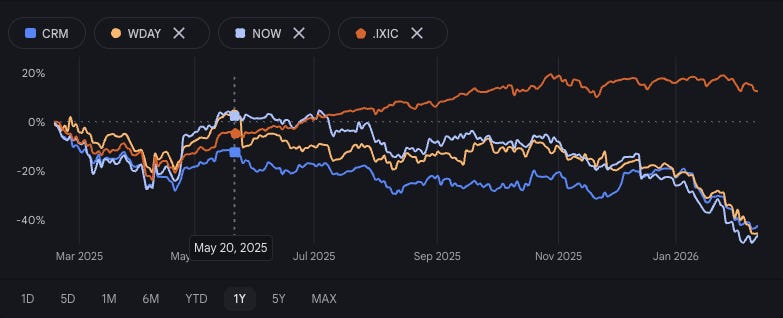
The start of Q2 was the point when Cursor had begun penetrating enterprise, Claude Code was released, Codex was released, and Sonnet 4.0.
The fall steepened about 2-3 months ago, which coincided with the release of Composer-1, Codex-5.1-Max, Opus 4.5, and Codex-5.2.
These two moments (Q2 2025 and Q4 2025) were breakpoints. There will be more, likely at an accelerating cadence.
I’m a believer in efficient markets. This isn’t the effect of a single event or a single market participant; it’s just that the market has become bullish on foundation models, agentic applications (more on this soon), data centers, and hard tech... and legacy SaaS gradually fell out of favor.
Cheaper code means more challengers, and buyer leverage
Price is set by the marginal (comparable) supply.
When a barrel of oil fell from $106 to $26 / barrel in 2014-15, what do you think the oversupply was in the market? 5%? 10%?
It was 1%.
Software is not a commodity like oil, but all pricing is market-driven. We are already seeing an explosion of software especially in the major system of record categories, even if none of them have unseated the 800lb gorillas.
Yet.
Give it a couple of years. Rippling and HiBob are already giving Workday a run for their money in mid-market / small enterprise. What do you think will happen when there are TEN such challengers in 2030? We’re already seeing this in the GTM stack with probably 5-10 upstarts challenging Salesforce and Hubspot.
You still think Workday, ServiceNow, and Salesforce will command the same pricing power they do today?
All it takes for them to lose a few deals here and there... and their hand will be forced. They’ll start discounting. They’ll hesitate to increase prices during a renewal. The sales narrative of “where else are you gonna go” will unravel, and customers will smell blood in the water. The moat is drying up, and the fortifications are showing their age.
This potential weakening is already factored into the reversion to the mean, but it will also show up directly in fundamentals. A System of Record company with
15% growth will trade at ~10x revenue (exactly where WDAY 0.00%↑ was trading in May last year)
8% growth will trade at ~8.5x revenue (CRM 0.00%↑ was at 8x)
But an application layer company (something that is more hot-swappable) growing at 5% with 70% gross margin due to pricing pressure trades at ~4x revenue. This is a hypothetical bear case, so we haven’t seen a drop this steep. But if any of these companies see falling renewals, gross margins, or pricing power... that’s where the multiples will go.
And so... a Heat-Death
If this weren’t enough, there’s a big “why now”. The ace up the sleeves of the AI-native companies is that they will be good at building agentic, augmented experiences, and incumbents will not. I’ve backed several companies based on this thesis — Monaco (totally different vibe to Salesforce), Puzzle vis a vis Quickbooks, or Rillet against Netsuite.
However: I’m not saying these companies will go quietly into the night. Every single one of these companies now lists themselves as an “AI-native X” or “Agentic Y”, but I’m yet to see a single example of how Workday is actually “The enterprise AI platform for people, money, and agents.” (???)
But few (if any) will make the transition into being a market leader in the AI era, because what it takes to succeed as an “AI Native system of record” is totally different from what it took to succeed as a “cloud system of record”.
The companies that will win this next era will need to serve as an Agent Substrate. This does not mean slapping a chatbot on the legacy interface. (If you’re wondering what the hell I’m talking about... Part II coming tomorrow: the Rise of the Agent Substrate).
I do not believe legacy SaaS companies will make the leap to the new paradigm of selling output + outcomes, instead of software... any more than IBM made the leap to being a “cloud” company successfully — their Red Hat acquisition notwithstanding.
“But wait!” you might say. “IBM has 9xed in the last 40 years!”
But the Nasdaq has 70xed in that time. Legacy SaaS companies will not go to zero, but they will gradually become irrelevant. And it will look and feel a lot worse, because everything is faster now; this decline won’t happen over 20-40 years, but rather over the next 5-10 years.
The heat death of the universe is the projected final state where maximum entropy is reached, resulting in a cold, dark, and empty cosmos.
Software ate the world, and now agentic coding is eating software. That’s how legacy SaaS companies will go. Not with a bang, but with a whimper.